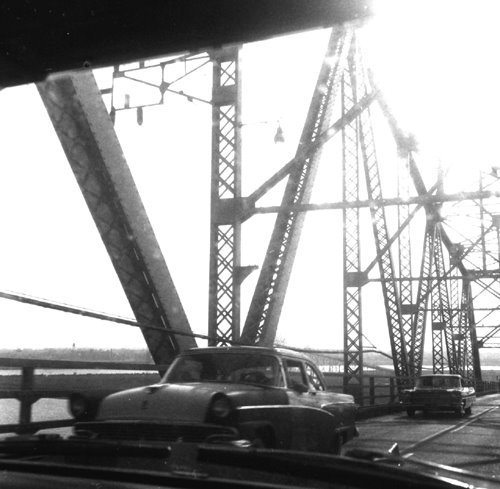
Oh, This? I Made It In My Shop.


My dad was a carpenter.
Then a cabinetmaker.
For a long time he retro-fitted drug stores and then he built bars.

Charleston was officially "dry" in the 1950s but Dad created a LOT of backbars, curved bars with "nosing"
* and even padded banquettes.
In his
"illegal" wood working shop.
 Ansonborough
 was a bit run down in those days and money was tight.
The fact that my Dad was cutting wood, hammering and then sticking finished products out the front window to get them to his truck was sorta overlooked.
My younger brother is shown helping Dad because he didn't scoot away in time.
All three boys knew the sound of that truck and it usually meant unloading many, many long pieces of wood or sheets of splintery plywood.
My older brother is totally absent on this particular
"Delivery" day.
As soon as I set down my camera, I joined my brother in the back of the truck to hold on to things as we delivered this piece over the old Cooper River Bridge. The very narrow 2-lane Grace Memorial.
Haven't seen shots like this in any coffee table books about Charleston.
(
*Nosing is the raised portion along the front of a bar top that keeps your sleeves off anything spilled on the bar.)
Labels: backbar, banquette, cabinetmaker, carpenter, coffee table books, Grace Memorial Bridge, lumber, plywood, splinters
Old photos of the Old Cooper River bridge..
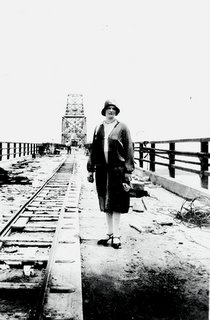
Now that the last of the Grace bridge has been blasted down, I would like to share some photos from the Boyd family album taken when the Grace was going up.
My grandmother was into the Charleston hospitality industry early on. She was f&b at the Charleston Country Club in the early 1920s, ran a boarding house in the late 20s and was head of a Navy Yard canteen (kitchen/messhall) during WWII.
Her boarding house on Meeting Street was home to several steel workers on the 2-lane Grace bridge as well as a supervisor. Since he was a guy in charge, he took my grandmother up onto the bridge in the middle of construction. It's 1928 and no hard hat for Granny. There she was in her stylish cloche hat, dusty patent leather shoes and a prim purse next to the tracks used to haul steel up the span.
He also gave her several photographs that I shared with the Post and Courier when it was doing a 75th anniversary issue about the bridge.
The Boyd bridge connection continued in 1946 when my dad, her son, worked on the Bailey Bridge to reconnect the Grace when the span was knocked out.
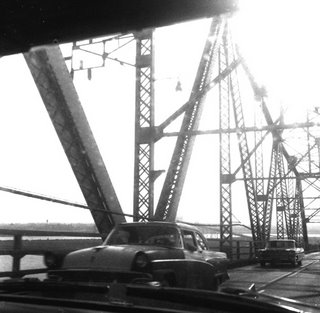
Finally, during a visit in 1964, I was able to balance a camera and snap a picture while driving over the Grace in heavy 2-way traffic as I had done many times while growing up in Charleston. (Many times driving over the bridge, not many times taking pictures.)
I survived that crossing.
Yes, I do have a LARGE piece of the Grace on display in my home.
Labels: boarding house, bridge construction, canteen, Charleston Country Club, Charleston Navy Yard, Grace Memorial Bridge


 Charleston was officially "dry" in the 1950s but Dad created a LOT of backbars, curved bars with "nosing"* and even padded banquettes.
 Ansonborough was a bit run down in those days and money was tight.